Tracing the space between knowing and saying – Nina Pejović’s Relay installation
We’ve all had the experience of thinking that something we said in a foreign language could have been expressed more beautifully, more precisely, or simply in an entirely different way in our native tongue. The interactive installation and publication Relay explores how our messages shift and take on new meanings as they pass through translation, and how errors accumulate along the way. It inhabits the space between thought and its expression in words, making the shifting nature of meaning something we can experience firsthand.
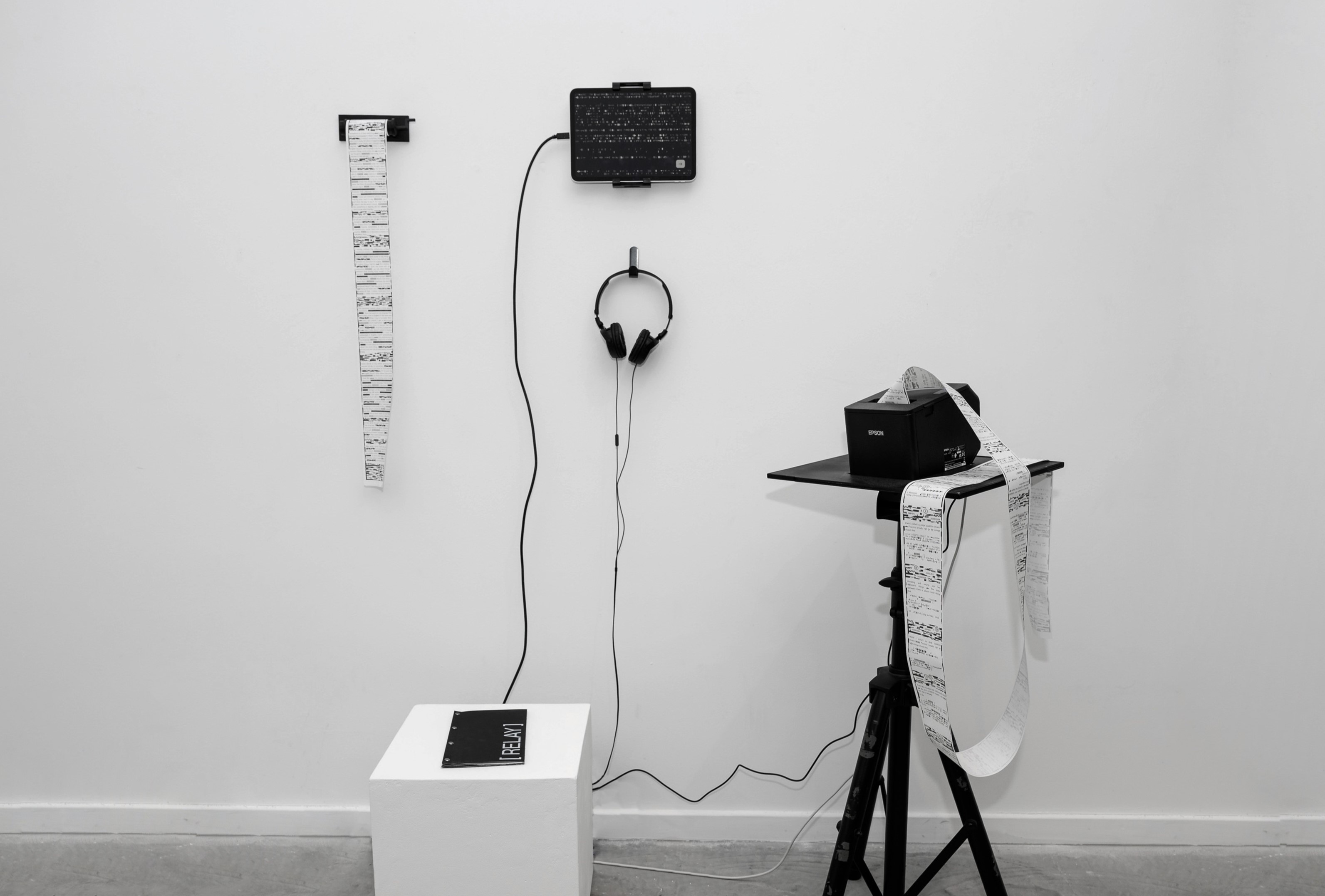
Nina Pejović: Relay installation view. Photo: Krsto Vulović
The starting point for this project was a personal situation. After arriving in Hungary for a master’s program expecting to study in English, I found myself in a Hungarian-speaking environment, surrounded by a language I could not understand. I started guessing what was being said, relying on tone, context, and other people’s translations. Over time, I became used to constructing what I thought was being said rather than actually knowing – and that experience started to change the way I understood language itself. What followed was a constant period of moving between three languages simultaneously, noticing that I was not quite the same person in each of them.
English became the language in which I think; my native language, Serbian, stayed emotionally closer but felt increasingly distant from daily life; Hungarian remained mostly out of reach. The distance between having a thought and being able to express it – something I had never noticed before – became very present. Words in my native language had no equivalents in English, and the explanations that replaced them never felt the same. Meaning was shifting constantly, underneath conversations that appeared to work just fine on the surface. That is what Relay is about.
Communication is often thought of as a process of transfer. A message leaves one person and arrives at another, and if both are paying attention and share a language, something close to the original intention is received. Relay tests how much of that holds when the message has to change languages on the way – building a structure in which the act of listening is followed by an act of translation, and the result of each translation becomes the source material for the next. What begins as one statement arrives, several translations later, as something related but changed: not broken, not failed, just reconstructed by every person and every language it passed through. Yet the work does not treat this as a problem or failure.
It aims to make the instability of meaning across languages visible and material, to give it a form that can be encountered directly rather than described from a distance.
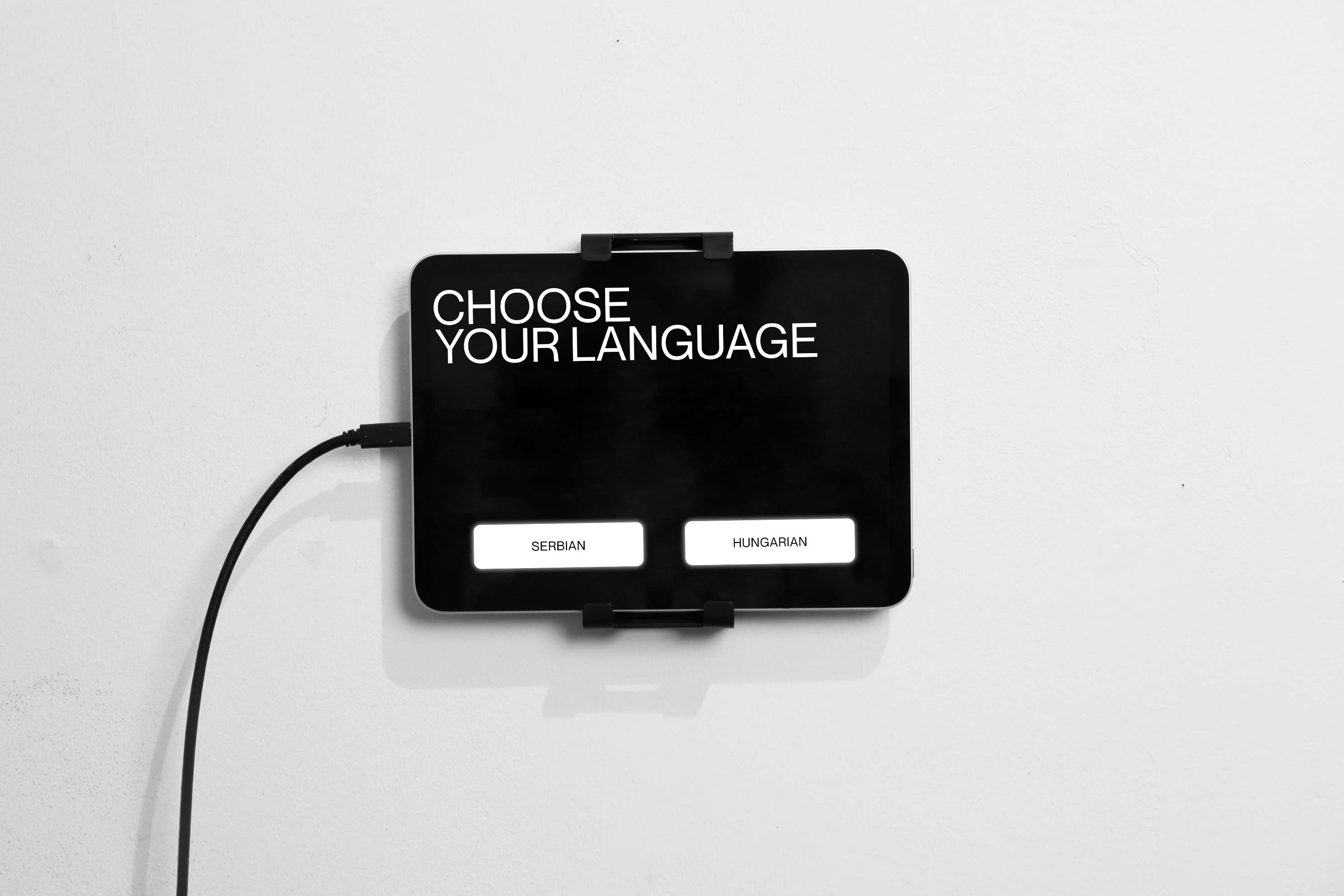
Nina Pejović: Relay installation view. Photo: Krsto Vulović
The Relay chain begins with one given sentence that names the condition the installation investigates before the investigation has even begun, and then, through the chain itself, demonstrates it:
“Knowing and saying are two different things. The space between them is where most things live.“
It is in that space where the work lives. It’s the gap that exists between having a thought and finding words for it, between what a word means to the person using it and what it means to the person receiving it, between the version that exists in one language and the closest thing that exists in another. These gaps don’t just appear. They are hidden within the effort of communication and remain invisible unless they are being brought up to the surface – by translation, that determines what survives and what quietly disappears.
Every translation in the chain moves through English. The chain alternates between Serbian and Hungarian speakers – a Serbian speaker translates into English, the next participant translates from English into Hungarian, the following one translates from English back into Serbian, and so on. The two languages never meet directly; English is always the shared ground between them.
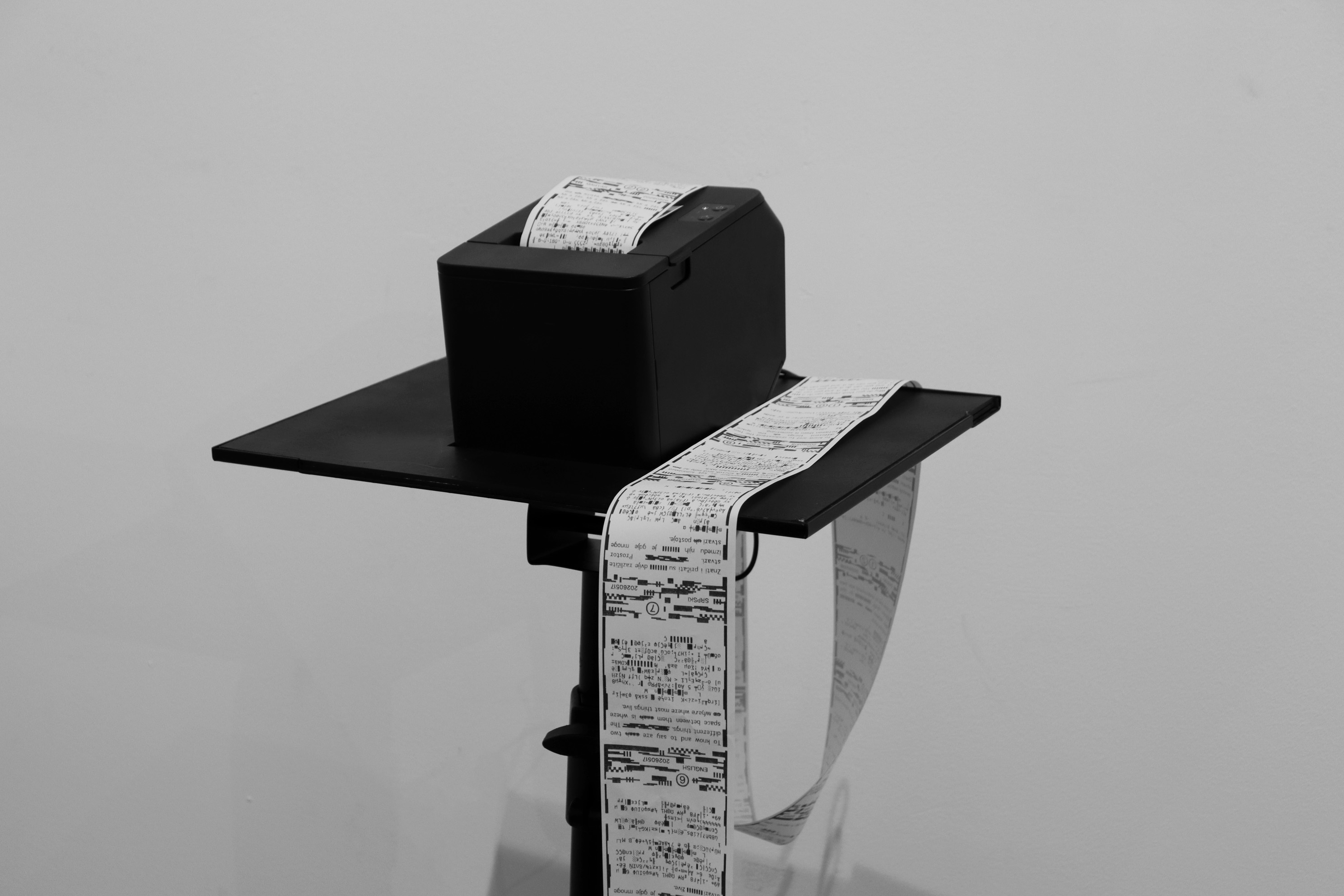
Nina Pejović: Relay installation view. Photo: Krsto Vulović
The machine that transcribes each recording participates in this, too. It listens, makes decisions about what it heard, and produces a text that is presented without explanation. Its output is incorporated in the printed record equally with everything else. In this way, it becomes another voice in the chain, with its own relationship to language and its own forms of approximation.
The participant listens to the recording once. They may listen again a second time if they choose to – but only once more, after which they must proceed to translation. This constraint is not random, as unlimited replay would change the nature of the task, turning oral translation into something closer to transcription. The one-replay limit preserves the conditions of actual communication, where a listener must work with what they caught and decide when they are ready to respond. The pressure this creates – the moment of translating before feeling fully ready – mirrors the actual conditions of communication across languages, where there is rarely time to find the perfect word or the most accurate equivalent. It also recreates something many bilingual speakers know well: the anxiety of committing to a version of a thought in a language that does not feel fully yours, knowing that what comes out may not be exactly what you meant.
Nina Pejović: Relay installation view. Photo: Krsto Vulović
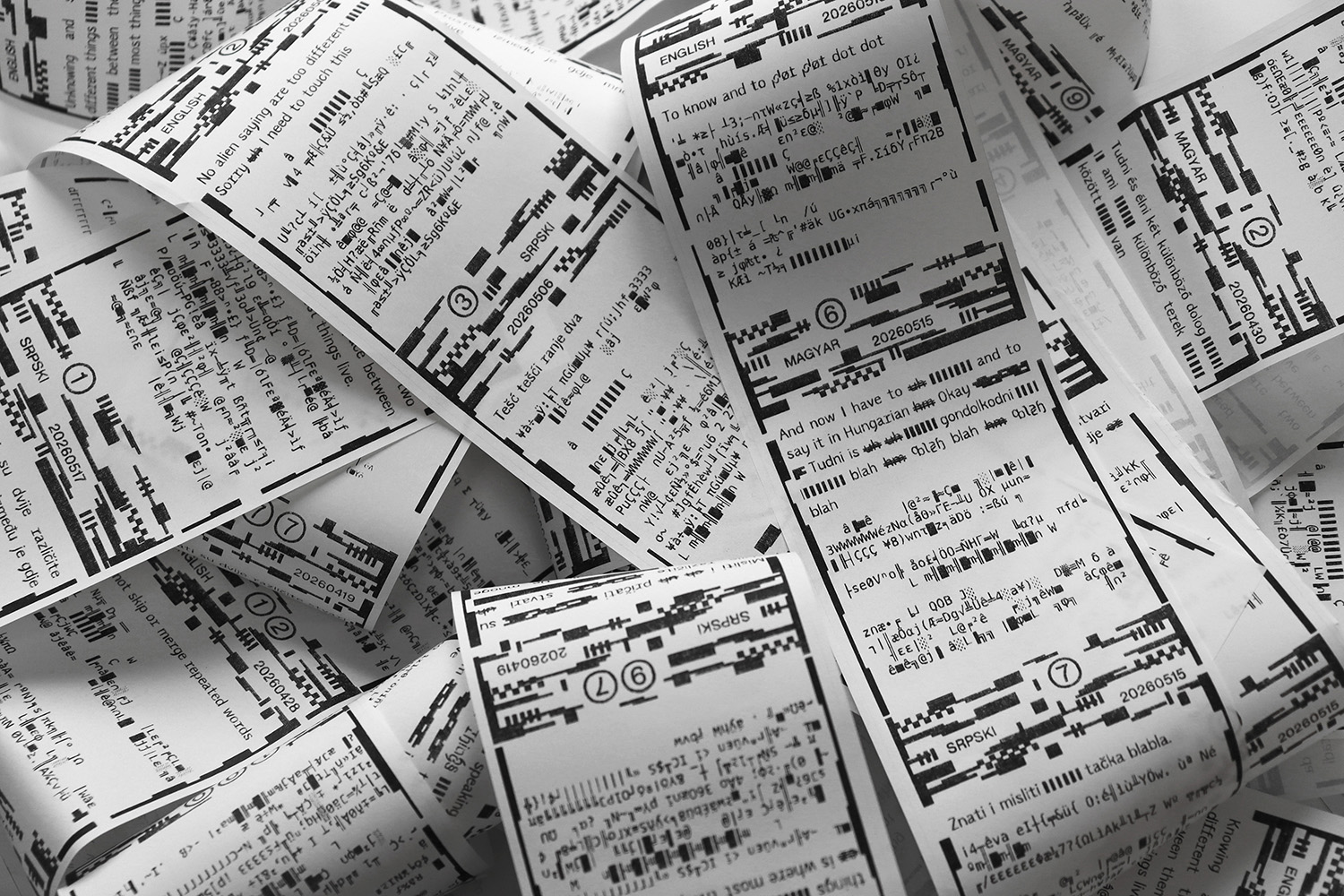
Each recording produces a printed transcript on a thermal paper roll that begins with an information area: a designed template, one of five cycling variants, carrying the serial number, date, and language of the recording in a geometric sans-serif typeface. Five frame variants exist so that no two consecutive transcripts are visually identical, giving each artifact individuality within a consistent system. Below the info area, the transcript body is set in a different typeface chosen for its legibility at the small sizes thermal printing requires and its visual distance from conventional document typography.
- Pauses are rendered inline, so when someone who has spent time reading the transcripts can sense the rhythm of the original speech just from looking at the page.
- Hesitation sounds – such as hmm, aah, uh, and similar non-lexical sounds that appear throughout natural speech – are transcribed as words but crossed with two horizontal lines, keeping them in the flow of the text while making them distinct from actual words.
- Repeated words are handled through a typeface shift: the first occurrence appears with distorted letterforms that make the word semi-readable, and the second appears in the regular form. The word can still be decoded, but it takes a moment, enough to signal that this word has already appeared.
Every transcript has a second text beneath it: the garble. It is generated from the binary content of the transcript’s own PDF, decoded through a character encoding pipeline. Because it derives from that specific document’s binary data, it is unique to each chain link – the garble of one transcript cannot be reproduced from another. It originated from a technical error that occurred while testing, but it was kept because it made sense conceptually. The garble contains real information – it is a direct encoding of the transcript above it – but it is completely inaccessible without knowing the system that produced it. Reading it feels like reading a language you are not familiar with and don’t have access to. It is not explained on purpose.
However, the garble is not confined to the transcript – it appears in the screensaver of the interface and across the publication as well, functioning as a visual thread that runs through every part of the installation.
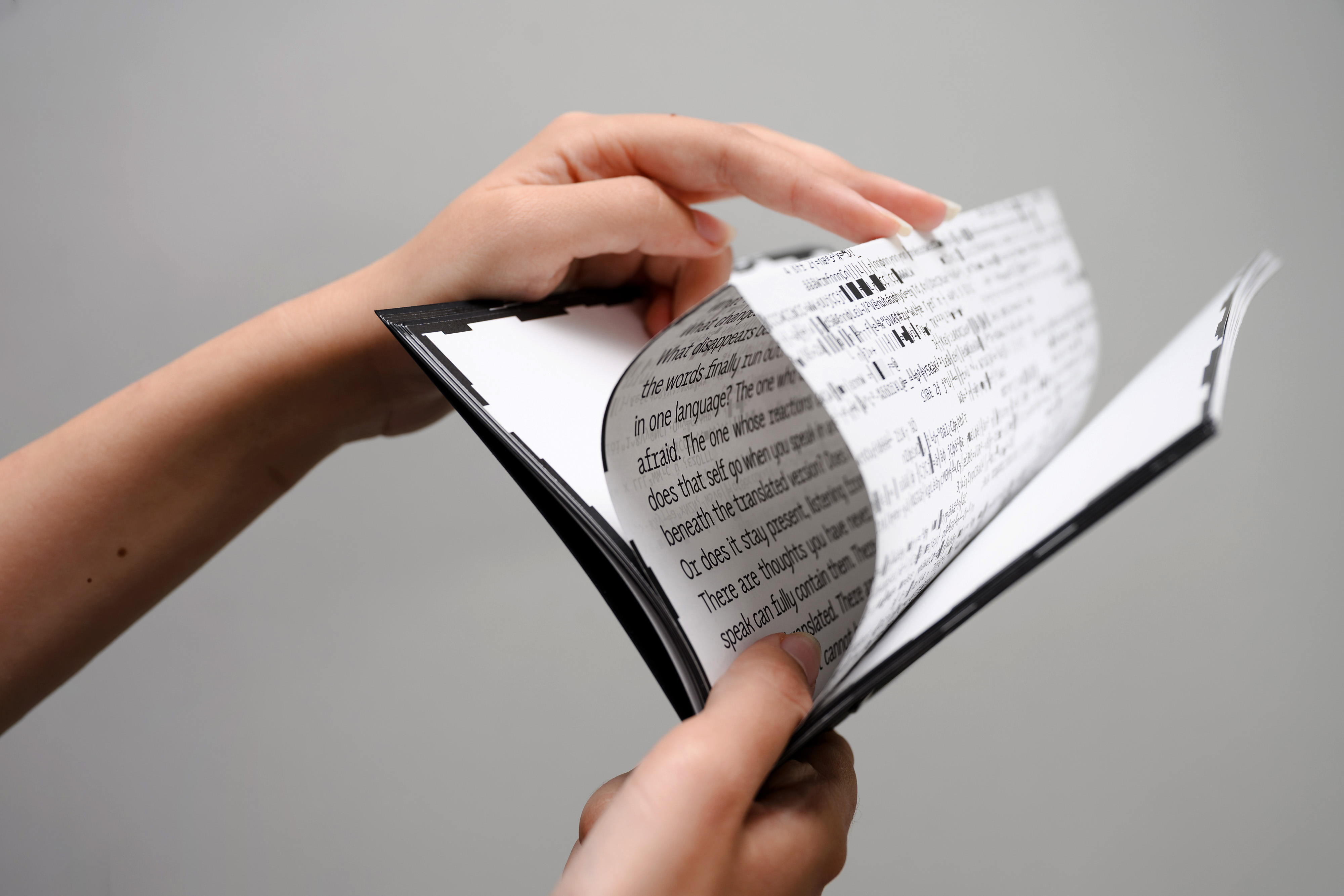
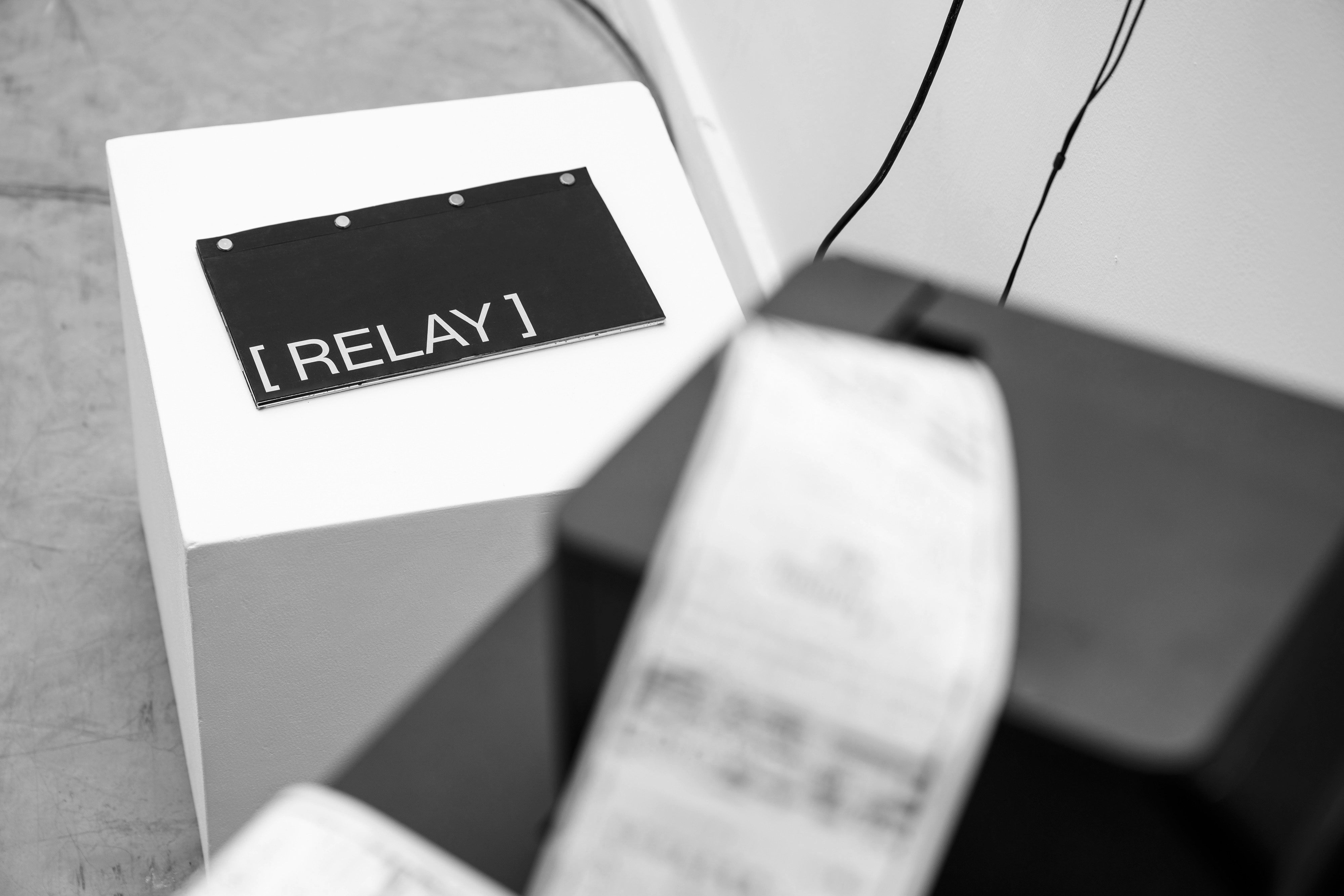
Nina Pejović: Relay publication. Photo: Krsto Vulović
The publication accompanying Relay is single-bound, consisting of two parts, designed to be read as an extension of the installation rather than a document about it. It is designed to be experienced with the same attention the installation asks for – some things in it are immediately accessible, others require effort.
Every element of the work – the interface, the transcript system, the garble, the publication, the personal transcript – is oriented toward the same thing: to make the instability of meaning across languages available as a direct experience rather than just a concept. Participants are not observing the process from the outside. They are inside it, receiving someone else’s version and producing their own. The transcript that prints after their recording joins the ones that came before it – a document of the chain that grows throughout the exhibition. Ultimately, Relay proposes that communication does not necessarily fail – but that it is always more complicated than it appears.
// /
The project was developed at the Graphic Design MA program at Moholy-Nagy University of Art and Design, supervised by Petra Pilbák, with Ágoston Nagy DLA as consultant.